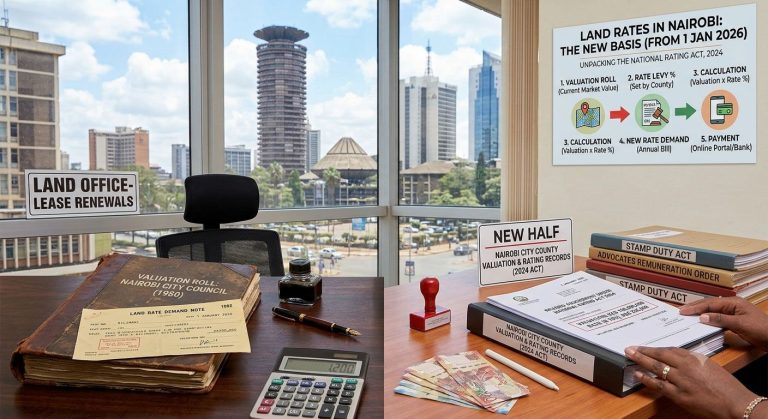
Nairobi Just Repriced Land Rates for the First Time in Forty Years

For most of the last four decades, land rates in Nairobi were calculated against property values recorded in a valuation roll drawn up in 1980 and implemented in 1982.

Think about what that means. The bill for a plot in Kilimani or Lavington was anchored to what that land was considered to be worth before the neighborhood existed in anything like its current form. Nairobi’s land values have moved several orders of magnitude since. The rates bill did not.

Read Article

The Real Cost of Buying Property in Kenya

Stamp duty, advocate’s fees, valuation, registration, searches and taxes. A clear breakdown of every closing cost in a Kenyan property purchase, and who pays what.

Property in Kenya is advertised at one number and completed at another.

Read Article

The Countdown Hidden in Your Title Deed

Almost every property transaction in Nairobi involves a leasehold title, and almost no conversation about one involves the expiry date.

It is printed on the document. It is often decades away, which is exactly why nobody reads it. But leases granted in the colonial and early independence periods — 33, 50, 66 and 99-year terms, many issued between the 1920s and the 1960s — are now reaching the end of their terms across the city.

Read Article

The Title Most Nairobi Apartment Owners Have Never Actually Read

Ask most apartment owners in Nairobi what they own, and they will say “my flat.” Ask what document proves it and the answer is usually less certain — a file somewhere, handled by a lawyer, at the time of purchase.

That document matters more than almost anything else about the property. In a large number of Nairobi apartment blocks, particularly those built in the 1990s and 2000s across Kilimani, Kileleshwa, Westlands and Parklands, it is not the document owners assume it is.

Read Article