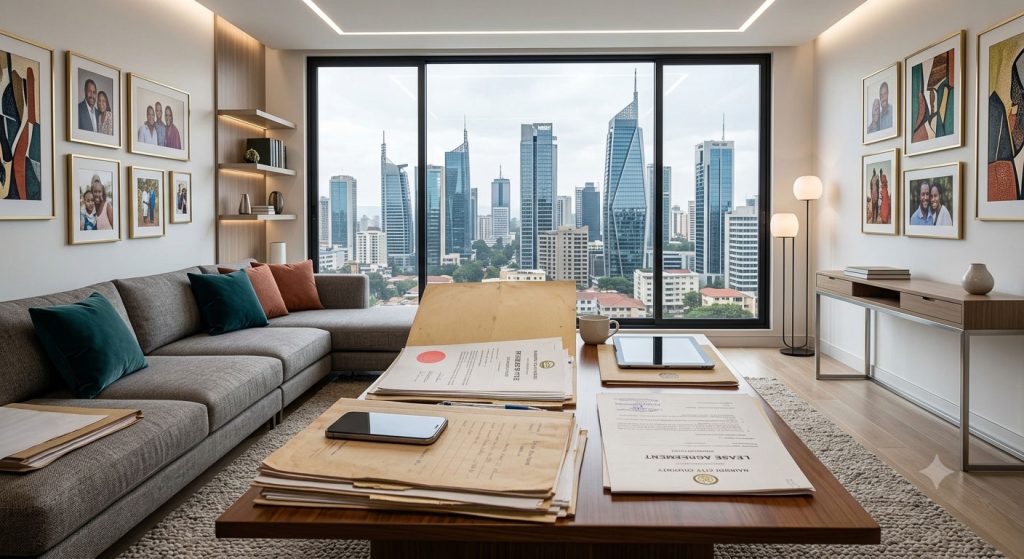
Ask most apartment owners in Nairobi what they own, and they will say “my flat.” Ask what document proves it and the answer is usually less certain — a file somewhere, handled by a lawyer, at the time of purchase.
That document matters more than almost anything else about the property. In a large number of Nairobi apartment blocks, particularly those built in the 1990s and 2000s across Kilimani, Kileleshwa, Westlands and Parklands, it is not the document owners assume it is.
This article explains the difference between the two forms of apartment ownership in Kenya, why the law changed, and how to find out in an afternoon which one applies to you.
Two documents that look similar and are not
The long-term sublease.** For decades, this was how apartments were sold in Kenya. A developer held the land under a single title — the “mother title.” Buyers were issued a sublease over their unit, commonly for 99 or 999 years, carved out of that mother title.
On paper this looks like ownership. In law it is something narrower. The underlying land title stays with the developer, who retains what lawyers call a reversionary interest. You hold a long lease of a defined space; you do not hold a registered title to it.
The sectional title
Under the Sectional Properties Act, 2020, a building is divided by a registered sectional plan into individual units and common property. Each unit owner receives their own certificate of title or certificate of lease, which includes their proportionate share of the common property. The mother title is closed. The unit becomes a distinct, separately registered parcel.
The practical difference shows up at three moments: when you sell, when you borrow against the property, and when something in the building needs collective decision-making.
Why the law changed
Parliament passed the Sectional Properties Act, 2020, which came into force on 28 December 2020, to replace a 1987 statute that had not kept pace with how Kenyan cities were actually being built.
The problems with the old model were structural rather than theoretical.
Conveyancing friction: Selling a subleased unit means working through the developer’s reversionary title. If the developer has been dissolved, changed hands, or simply cannot be traced two decades later, that becomes slow and expensive — and it is your buyer’s lawyer who raises it, at the point when you have the least leverage.
No proper legal body for the building: Owners in the same block had no statutory mechanism to constitute themselves as a body that could manage common areas, levy service charges and enforce obligations against each other. Many blocks operated through informal management companies with unclear legal standing.
Weak security for lenders: A bank taking security over a unit that has no independent title is in a different position from one taking a charge over a registered sectional unit. That affects both your ability to borrow and your buyer’s.
The Act was also written to work alongside the Land Registration Act, 2012, so that unit ownership sits within the same registration system as every other parcel of land in Kenya.
The conversion requirement
Section 13 of the Act requires long-term subleases — those over 21 years, intended to confer ownership of an apartment, flat, maisonette, townhouse or office, and registered before the Act commenced — to be brought into conformity with section 54(5) of the Land Registration Act. The Act set a two-year window from commencement.
Conversion can be initiated by the developer, by the management company, or by an individual unit owner. The Sectional Properties Regulations, 2021 set out the forms and procedure. In broad terms, it requires a licensed surveyor to prepare a sectional plan based on the approved building plans, register that plan, and constitute a management corporation to hold the reversionary interest for the owners.
Where conversion has not happened, the consequence provided by the Act is that the Registrar may register a restriction against the title — which blocks further dealings with it.
A note on dates: The statutory two-year window ran from 28 December 2020. In practice, implementation has been uneven, timelines have moved, and different firms describe the current position differently. Rather than rely on any published date, the useful step is to establish what your own title says now. If a restriction has been registered against your building’s title, you will find out at the point of sale, which is the worst possible moment.
How to check what you hold
This is a short, cheap exercise and worth doing whether or not you plan to sell.
- Find your title document: It will be with your advocate, your bank if the property is charged, or in your own file. Read the first page. A sublease will describe a term of years granted out of a larger parcel. A sectional title will refer to a unit number on a registered sectional plan and state your share in the common property.
- Do an official search: A search at the relevant land registry, or through Ardhisasa, shows the current registered position on the parcel — including any restriction or encumbrance. This is inexpensive and is the only authoritative answer.
- Ask your management company two questions: Has a sectional plan been registered for this building? Has a management corporation been constituted under the Act? If nobody can answer, that itself is informative.
- If conversion has not happened, find out why: Common causes include a mother parcel that has not been geo-referenced, a developer who cannot be traced or is unwilling to surrender the original title, or units that have not all been transferred. Each has a different route through, and the Act does allow the Registrar to dispense with production of the original title in certain circumstances where the developer is unavailable.
- Take advice from your own advocate: Not the developer’s, and not the management company’s. Conveyancing in Kenya must be handled by an admitted advocate in any event.
Why this matters if you are buying
If you are considering an apartment, particularly in an older block, add three questions to your list:
- Is the unit registered under a sectional title, or is it still a long-term sublease?
- If it is a sublease, has conversion been started, and by whom?
- Is there a management corporation constituted under the Act, and can you see its by-laws and accounts?
A seller or agent who answers these confidently is telling you something useful. One who cannot is also telling you something useful.
Newer developments are generally being set up under the sectional regime from the outset, which is the point of the legislation. The exposure sits mostly with older stock — and with buyers who assume that because a building is smart and well-located, its paperwork must be in order.
—
*This article is general information, not legal advice. Anyone dealing with a specific property should take advice from their own advocate.*
*Sources: Sectional Properties Act, No. 21 of 2020; Sectional Properties Regulations, 2021; Land Registration Act, No. 3 of 2012.*