
For most of the last four decades, land rates in Nairobi were calculated against property values recorded in a valuation roll drawn up in 1980 and implemented in 1982.
Think about what that means. The bill for a plot in Kilimani or Lavington was anchored to what that land was considered to be worth before the neighborhood existed in anything like its current form. Nairobi’s land values have moved several orders of magnitude since. The rates bill did not.
That has now changed. From 1 January 2026, Nairobi City County levies land rates on a new basis, under the National Rating Act, 2024.
Almost nobody has explained what this means for an ordinary property owner. Here is the explanation.
What land rates are, and what they are not
Two annual charges are routinely confused, and they are not the same thing.
- Land rates- are paid to the county government. They are a charge on rateable property within the county.
- Land rent (ground rent) is paid to the national government, on leasehold land, under the terms of the lease.
Different recipients, different laws, different platforms, different due dates. Paying one does not discharge the other, and a clearance certificate for one is not evidence of the other.
Land rates matter disproportionately to Nairobi because they are the county’s single largest own-source revenue item, accounting for roughly a quarter of what it collects.
What changed on 1 January 2026
Nairobi City County gazzetted a new rating structure under sections 15(3) and 56(1) of the National Rating Act, 2024. Two categories apply.
Flat rate zones, charged by parcel size:
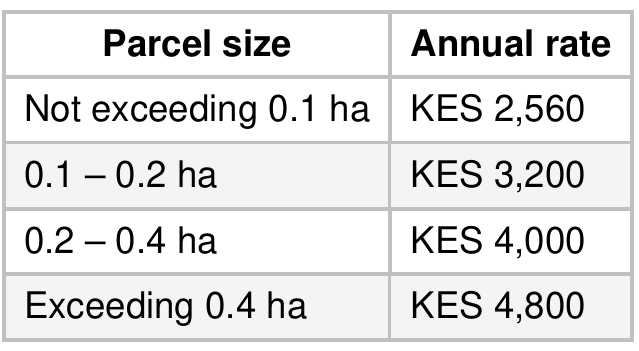
Valuation properties — residential, commercial and agricultural parcels covered by private or public valuation — charged at 0.115% of unimproved site value (USV) per year, based on the 2019 Draft Valuation Roll.
“Unimproved site value” is the value of the land itself, disregarding the buildings on it. Your house does not increase your rates. The land under it does.
The two cushions
The county did not apply the new figures without transition, and the two moderating provisions are the part most owners have not registered.
- A floor. If the newly calculated rate comes out lower than what you paid in 2022, you continue paying the 2022 figure. Nobody’s bill goes down.
- A ceiling. If the newly calculated rate comes out at more than double the 2022 figure, you pay double the 2022 rate rather than the full new amount.
That cap is doing significant work. For land in areas where values have risen sharply since 1982 which is much of Nairobi the uncapped figure would be a very large multiple of the old one. The cap converts a cliff into a step.
It also means the current bill is not the settled position. A cap is by nature transitional.
If you objected to the 2019 Draft Valuation Roll
The valuation roll underpinning all of this is a draft, and it carried an objection process. The county’s notice was explicit: property owners who lodged objections should not pay the new rate until their cases are heard and determined, and continue on the old basis in the meantime.
If your property was not valued at all, or is missing from the roll, the guidance is to contact the Chief Valuer at City Hall.
The National Rating Act, 2024 also established a National Rating Tribunal to hear and determine valuation and rating disputes a dedicated forum that did not previously exist. If you believe your parcel has been overvalued, there is now a defined route, and it is worth taking advice on it rather than simply paying a figure you think is wrong.
Why the law behind this changed too
The National Rating Act, 2024 was assented to on 4 December 2024. It repealed the Rating Act and the Valuation for Rating Act — statutes dating from the 1960s — and replaced them with a single national framework.
Among its changes:
- Counties have exclusive authority over rating, aligned to Article 209(3)(a) of the Constitution
- An Office of the Chief Government Valuer as principal adviser on valuation, with a role in standardizing valuation rolls nationally
- The National Rating Tribunal for disputes
- Public participation requirements before rating structures and valuation rolls are adopted
- A broadened definition of rateable owner, which expressly includes long-term leaseholders on terms of 21 years or more, and executors managing a deceased person’s property
- A transition window for counties to align their own legislation
That last point is why this story is not finished. Other counties are working through the same alignment, and Nairobi’s own roll remains a draft with objections outstanding.
The reason this becomes urgent at sale
Rates arrears attach to the property.
A rates clearance certificate from the county is required before a transfer can be registered. If the certificate cannot be issued because there are arrears, the sale does not complete until they are paid usually by the seller, under time pressure, with the buyer’s advocate holding the timetable.
Arrears also attract penalties and interest, and the county publishes lists of defaulters with enforcement action, including auction, stated as available.
Two practical consequences:
- If you are selling, request a rates statement before you list, not after you have a buyer. Interest can exceed the principal on long-standing arrears, and you want to know the figure while you still have time to deal with it.
- If you are buying, make production of a valid rates clearance certificate an express condition of completion, and confirm the position with your own search rather than relying on the seller’s assurance. Where arrears exist, they are negotiable against the price — but only if you find them before you sign.
How to check your position
Nairobi County provides a self-service route through its e Services portal, where you can look up a property by title or LR number, view the balance including any penalties and interest, pay, and generate a rates clearance certificate.
Land rent, being a national government charge, is checked separately through Ardhisasa.
Counties periodically run amnesty windows waiving penalties and interest for owners who clear the principal. These are announced with limited notice, so if you are carrying arrears it is worth watching for one.
What to do this month
- Look up your rates balance and confirm whether your property is in a flat rate zone or under valuation.
- If you objected to the 2019 Draft Valuation Roll, confirm your objection is on record and check its status.
- If your property is missing from the roll, contact the Chief Valuer.
- Clear any arrears, or find out the exact figure so it does not surprise you at sale.
- Diarise the annual due date and pay on time. Penalties on land rates compound quietly and are entirely avoidable.
This article is general information, not legal or tax advice. Rating structures change; confirm current figures with Nairobi City County and take advice from your own advocate on any specific property.
Sources: National Rating Act, 2024; Nairobi City County gazette notice on 2026 land rates; 2019 Draft Valuation Roll; Constitution of Kenya, 2010, Article 209.