
Stamp duty, advocate’s fees, valuation, registration, searches and taxes. A clear breakdown of every closing cost in a Kenyan property purchase, and who pays what.
Property in Kenya is advertised at one number and completed at another.
The gap is not hidden, exactly. Every item in it is set out in a statute, a gazetted order or a published fee schedule. But nobody assembles the list in one place for buyers, and the result is a familiar scene: a purchase agreed at the top of a budget, and a scramble weeks later for a sum that was always going to be payable.
This is the list. Percentages and structures are as we understand them at the time of writing; rates change with each Finance Act and by transaction type, so confirm the current figures with your advocate before you budget.
The buyer’s costs
1. Stamp duty — the largest single item
Stamp duty is charged under the Stamp Duty Act on the value of the property, and is payable by the buyer.
The rate depends on where the property sits:
- 4% in municipalities, which includes all of Nairobi
- 2% in rural and agricultural areas
The duty is assessed on value, not simply on the price you agreed. A government valuer inspects the property and determines its value for duty purposes before the transfer can be registered. If that assessment exceeds your purchase price, duty is charged on the higher figure which is a specific reason not to plan your budget on the assumption that duty equals four per cent of what you paid.
On a KES 20 million Nairobi property, budget from KES 800,000.
Stamp duty must be paid before the title can be registered in your name. There is no route around it. Certain transactions are exempt your advocate will advise on whether yours is one.
2. Advocate’s fees
Under the Advocates Act, conveyancing in Kenya must be carried out by a licensed advocate. The land registry will not register a transfer prepared by anyone else. This is not optional.
Fees are governed by the Advocates (Remuneration) Order, which prescribes a minimum scale based on the value of the transaction. The scale is progressive: a higher percentage applies to the first tranche of value and reduces on the balance, so the effective rate falls as the price rises. In practice most sources describe smaller transactions as landing near 1.5–2% and larger ones lower, with a floor in the region of KES 35,000.
Two things to watch.
- The scale sets a minimum, not a maximum. Advocates cannot lawfully charge below it. Quotes of a few thousand shillings for a full conveyance should be treated as a warning rather than a bargain.
- VAT applies. Legal services attract VAT at 16%, charged on the fees. Factor it in.
The Remuneration Order also makes clear that scale fees cover the professional work, not disbursements stamps, valuer’s charges, agent’s fees, search fees, registration fees and similar are separate and additional.
3. Valuation and survey
A government valuation is part of the stamp duty assessment. Around it sit auxiliary costs — site visits, documentation, processing — which are commonly described as scaling with value.
You may separately want your own valuation, particularly if you are borrowing, since your lender will require one. And if the parcel needs a physical survey or a mutation, a licensed surveyor’s fees apply.
4. Registry and search fees
These are individually small and easy to overlook, but they are real:
- Official searches- at a modest per-search fee. You will do more than one — at minimum a search before signing, and often a further search shortly before completion to confirm nothing has changed on the register.
- Registration fees- for the transfer instrument, which vary by registry and transaction type.
- Consent fees- where a leasehold transfer requires the consent of the lessor or the National Land Commission.
- Land Control Board consent- where the property is agricultural land.
5. Nominal duty on the agreement
The sale agreement itself is stamped, at a small nominal amount. It must be stamped within 30 days or penalties accrue. An unstamped agreement cannot be relied on in court which is precisely the situation in which you would want it.
6. If you are borrowing
A charge or mortgage over the property attracts stamp duty on the amount secured, plus the bank’s own arrangement, legal and processing fees. Your lender will set these out; ask for them in writing at offer stage rather than at completion.
7. Rates and rent apportionment
Land rates are payable to the county and land rent, on leasehold property, to national government. These are apportioned between seller and buyer at completion, and the seller must produce clearance to enable the transfer.
The seller’s costs
Capital Gains Tax
CGT is payable by the seller at 15% of the net gain the difference between the transfer value and the adjusted cost, which includes acquisition cost and allowable improvements. Exemptions exist. Sellers should take advice early, because the calculation is rarely as simple as sale price minus purchase price.
Clearances
A seller must produce a rates clearance certificate from the county and, on leasehold property, evidence that land rent is paid up. Where the property is charged to a bank, the charge must be discharged, and discharges carry their own fee calculated on the amount secured.
Sellers with rates arrears frequently discover them at exactly the wrong moment. Requesting a statement before you list, rather than after you have a buyer, is worth doing.
Agent’s commission
Where a licensed agent is instructed, commission is payable per the agency agreement.
A worked illustration
For a KES 20 million residential property in Nairobi, bought without a mortgage, a buyer’s closing costs might be assembled roughly as follows:
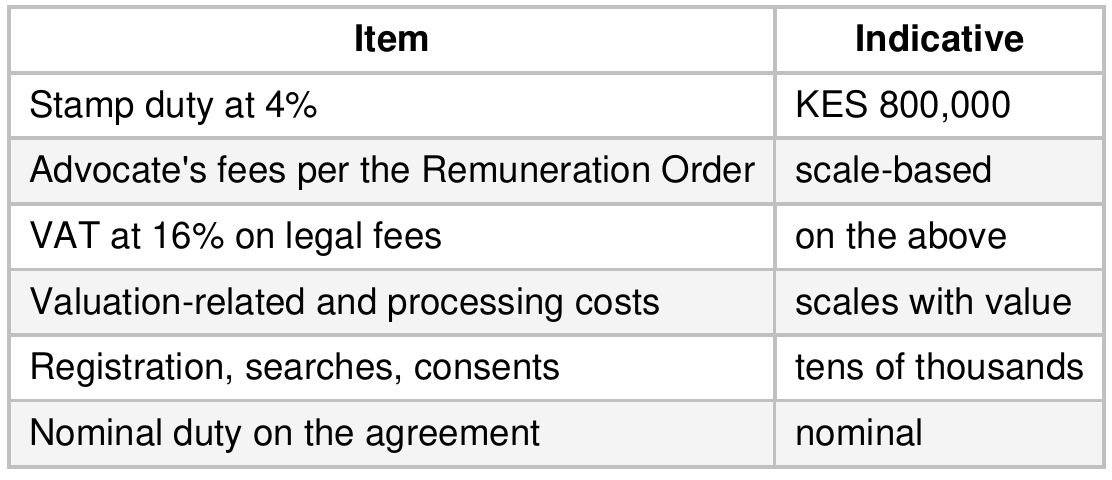
The dominant item is stamp duty. As a rough planning figure, buyers commonly find total closing costs land somewhere around 5–7% of the purchase price but that is a budgeting starting point, not a quote. Get an itemized estimate from your advocate before you commit.
Five practical rules
- Budget closing costs as a separate line from the deposit. They are not part of the purchase price and cannot be borrowed against the property.
- Never pay in cash, and never into a personal account. Funds should be held by an advocate as stakeholder, jointly, or in escrow, and released on completion.
- Get the fee estimate in writing before instructing. An itemized estimate separating professional fees from disbursements lets you check both.
- Structure instalments against milestones. On an off-plan purchase, payments tied to construction stages rather than calendar dates keep your exposure aligned with progress.
- Instruct your own advocate. The seller’s advocate acts for the seller. This is the single most common false economy in Kenyan property, and it is the one that costs the most when it goes wrong.
This article is general information, not legal or tax advice. Rates and fees change; confirm current figures with your advocate and with KRA before relying on them.
Sources: Stamp Duty Act (Cap 480); Advocates (Remuneration) Order; Advocates Act; Income Tax Act (capital gains); Land Registration Act, 2012.